

Video: Kaine Slams Trump’s Illegal, Unpopular, Likely Corrupt War Against Venezuela on Senate Floor
WASHINGTON, D.C. – Today, U.S. Senator Tim Kaine (D-VA), Ranking Member of the Senate Foreign Relations Subcommittee on the Western Hemisphere and a member of the Senate Armed Services Committee (SASC), spoke on the Senate floor at length about President Donald Trump’s illegal, confusing, dangerous, unnecessary, unpopular, and likely corrupt war against Venezuela.
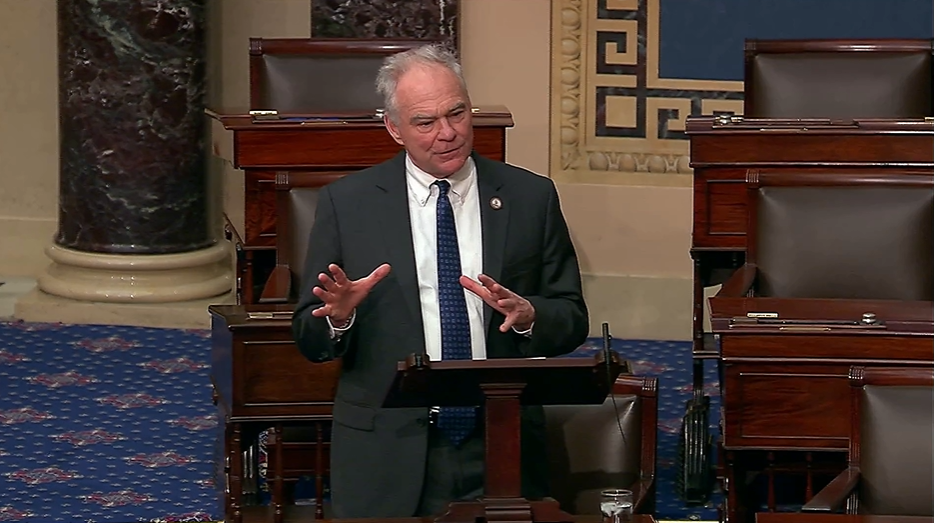
Broadcast-quality video of Kaine’s speech is available here.
Kaine, alongside U.S. Senators Rand Paul (R-KY), Chuck Schumer (D-NY), and Adam Schiff (D-CA), is forcing a vote this week on a War Powers Resolution to block the use of the U.S. Armed Forces to engage in hostilities within or against Venezuela unless authorized by Congress.
Kaine’s full speech as prepared is available here:
The news that President Trump had ordered an invasion of Venezuela on Saturday to capture Nicolas Maduro was a shock but not a surprise. Beginning with unauthorized military strikes against unknown persons in boats in the Caribbean and Eastern Pacific starting in early September, and continuing through the massing of U.S. military assets in the region over the past several months, the likelihood of this happening has been obvious to even a casual observer.
In November, I forced a vote on a privileged bipartisan war powers resolution to explicitly prohibit the use of the U.S. military to strike Venezuela without congressional approval. The Administration had not provided any clear rationale for its military pressure campaign, much less any legal rationale or request for congressional authorization for military action against the country.
All Democrats supported my resolution, and two Republicans did so as well. But there were insufficient Republican votes to pass it. Many of my Republican colleagues told me that President Trump was only bluffing and voted no for that reason. In the aftermath of this invasion, with the Administration claiming it has the right to seize Venezuelan oil and “run Venezuela” under the supervision of the U.S. Secretaries of Defense and State, and the President threatening to put boots on the ground and conduct additional strikes to control the country, we see that this was no bluff.
After this Administration’s actions over the weekend – which resulted in several injuries to U.S. servicemembers – Congress must tell the American people where it stands. I again ask my colleagues to vote on a resolution specifying that we should not wage military action within or against Venezuela unless Congress votes to authorize it. We’ll have that vote later this week, but I wanted to speak at some length tonight about why this is such an important vote for the Senate, the United States, and the world.
Speaking as the lead Democrat on the Foreign Relations Committee’s Western Hemisphere panel, I know far too well the despotic nature of Maduro’s rule in Venezuela. I have condemned it for years, as have all of my colleagues in the Senate. I have advocated forcefully for a democratic transition in Venezuela and supported Maria Corina Machado’s efforts to bring democracy to the country. This is not about whether Maduro is a bad guy – obviously, he is.
Because here’s the thing – I also speak as a member of the Senate Armed Services Committee, as a military Dad, and as a former missionary in Latin America. The use or misuse of American troops is very personal for me. And the role that the United States plays in Latin America has been a lifelong field of study and lived experience.
I was a 21-year-old student at Harvard Law School when I decided that I needed to take a year away from my studies to decide what to do with my life. I wrote a letter to Jesuit missionaries working in Honduras and offered to come volunteer with them. I found myself in El Progreso in September 1980, where I worked during that academic year to run a small technical school, teaching teenage boys carpentry and welding.
This was the pivotal year in my life and it put me on a path to serve others – as a civil rights lawyer for 18 years and an elected official for 30 years and counting. It fortified my Catholic faith, forged my fluency in Spanish, and taught me so many lessons about myself, my own country, and the circumstances under which so many people live in settings far less comfortable than what I was used to. I have drawn on those lessons every day for the last 45 years.
The families I worked with showed me how to live with grace under the most challenging conditions. And the Jesuit missionaries – Brother Jaime, Father Ramon, Father Patricio, and others – showed me how serving other people is the path to happiness. I can never repay the good they did for me, but my life has been an attempt to do so ever since.
The lessons of my time in Honduras were not all pleasant. When I was there, it was a military dictatorship and also one of the poorest countries in the Americas. People prayed for the day when they might have the ability to choose their own leaders. They hoped that they might have a future with a path out of the grinding poverty surrounding them. And I learned, much to my sorrow, of the many instances in which misery throughout the region was spread by the actions –sometimes intentional and sometimes not – of the United States.
When I was in Honduras, the military dictatorship suppressed political opposition and dissent and was supported by the U.S. in doing so. A long history of U.S. intervention in the country to protect the interests of American fruit companies left a legacy of corruption and underdevelopment whose consequences are still felt today.
Toward the end of my time in the country, the U.S. began secretly funding a band of rebels in southern Honduras to wage destabilizing military action against the government of neighboring Nicaragua, which had been ruled for decades by the U.S.-backed Somoza dictatorship until it was overthrown in 1979.
Another neighbor, El Salvador, was in the midst of a devastating civil war in which a right-wing government used U.S.-trained military and security personnel to murder civilians, including Catholic Bishop Oscar Romero, a few months before I arrived, and four American missionaries –Maura Clarke, Ita Ford, Dorothy Kazel and Jean Donovan – a few months after I arrived. This civil war led to more than 65,000 civilian deaths.
Yet another neighbor, Guatemala, had a similar longstanding civil war initiated after the U.S. engineered the overthrow of its popularly-elected government in 1954. This war lasted for nearly 40 years, with as many as 200,000 deaths and one million refugees.
This was all shocking to me as I tried to teach carpentry and welding to teenagers. The conflicts were at my doorstep, with refugees from violence in neighboring countries flooding into Honduras and the murder of bishops, priests and nuns spreading fear among the missionaries I worked with. And I was confronted with a most painful question: Why was the United States, my country, a nation that I loved, backing military dictatorships, death squads, overthrows of governments at the expense of poor people who were struggling so hard just to feed their families?
I came home a changed person – energized to serve others just as my mentors had – but also deeply concerned about the role the U.S. had played in many Latin American nations. This part of our history is not often taught here at home, because we have reason to be ashamed of much of it. But it is remembered very well throughout Latin America, and they see a U.S. military invasion of a sovereign nation today, to seize its oil, as a very sinister repeat of decades, generations, even centuries of a painful history.
The Trump Administration released a National Security Strategy in early December, and it announced a clear plan for the Americas: “After years of neglect, the United States will reassert and enforce the Monroe Doctrine to restore American pre-eminence in the Western Hemisphere and to protect our homeland and our access to key geographies throughout the region.” The Strategy prioritizes the Western Hemisphere first among all regions of the world.
The Monroe Doctrine goes all the way back to the 1820s. Let’s be clear about what it is. In the Doctrine, President James Monroe and his Secretary of State John Quincy Adams declared that the Americas were off-limits for European colonization or interference. While it was a foreign policy doctrine about the Americas, it wasn’t fundamentally about building good relationships with our neighbors.
Rather, it was about keeping Europe away. Initially, Latin American leaders appreciated that the U.S. clearly stated that European colonizers no longer had free rein to continue past practices that had used the region for plunder and slavery. But, over the years, Latin American leaders also came to see that the Monroe Doctrine had evolved to be more about American dominance than American partnership.
In the early 1900s, President Teddy Roosevelt expanded the doctrine to also assert the right of the United States to intervene in the domestic politics of all nations in the region. The Roosevelt Corollary was declared after economic challenges in Venezuela threatened the nation’s economy, thereby increasing the likelihood of default on international debts.
How ironic that Venezuela thus became the first use of the doctrine to justify U.S. military intervention into another nation’s domestic affairs, rather than just a defensive action to keep a European nation from intervening. The people of Venezuela know this history well, even though Americans have largely forgotten it.
This reinterpretation of the doctrine to allow U.S. intervention led to escalating U.S. military interventions in the region – Colombia, Haiti, Honduras, Nicaragua, Cuba, and the Dominican Republic were all affected in the first half of the 20th century. During World War II, the U.S. invoked the Monroe Doctrine to occupy Greenland after Germany occupied Denmark.
In more recent years, President Eisenhower authorized U.S. assistance for the overthrow of the Guatemalan government and a coup against the government of Brazil, President Kennedy authorized a U.S.-backed invasion of Cuba. President Johnson authorized U.S. troops to invade the Dominican Republic, President Nixon authorized U.S. support to assist the toppling of the government of Chile, President Reagan secretly funded the Contra War against Nicaragua and authorized an invasion of Grenada and the first President Bush authorized the invasion of Panama.
The collapse of the Soviet Union led to a few decades of relative calm in the relations of the United States and its neighbors, as we turned our attention to the global war on terror. But now President Trump pledges to revitalize the doctrine of American dominance in the Hemisphere and go ever further. In his own words:
“And the Monroe Doctrine is a big deal, but we’ve superseded it by a lot, by a real lot. They now call it the Donroe Doctrine.”
I’m not sure which marketing genius came up with the name “Donroe” Doctrine. It sounds comical, but it’s anything but humorous to Latin American nations whose history books are filled with examples of the U.S. using the military to interfere in their domestic politics.
And that brings us to President Trump’s invasion of Venezuela to arrest and depose its de facto leader and seize its oil. Nicolas Maduro was an incompetent dictator who stole the last election, which he clearly lost, and has presided over the economic collapse of a nation that was recently one of the most prosperous countries in the region.
But multiple things can be true, and it is also true that President Trump's haphazard initiation of a unilateral war against the country is a mistake of historic proportions that will make our country, region, and world less secure. And I hope to convince my colleagues – whether they believe the war is a good or bad idea – to stand up and support the constitutional requirement that the U.S. not wage war without a vote of Congress.
I assert that the military action against Venezuela is:
—illegal
—confusing in its true motives
—harmful to U.S. interests in the region
—a dangerous precedent if followed by our adversaries
—unnecessarily and suspiciously secret
—a frightening return to unnecessary forever wars
—unpopular and potentially corrupt
—profoundly disrespectful to U.S. troops
First, the war is illegal. As I’ve argued on the floor of this body for 13 years, and to presidents of both parties, only Congress can declare war – or in the modern phrase contained in the 1973 War Powers Resolution, authorize the use of military force in hostilities. This legislation was passed in response to the abuses of President Nixon, and builds off of one of the clearest parts of the Constitution: Congress, and only Congress, initiates war – and once initiated, the President, as commander-in-chief, executes the declared war.
The text of the Constitution is clear and its meaning is additionally clarified by the notes taken during the debate in Philadelphia concerning the adoption of the Constitution, the Federalist Papers written by those involved in drafting the Constitution and correspondence between the Founders of our nation. A narrow exception has been long understood – the President as commander-in-chief has the power and duty to defend the nation from ongoing or imminent attack without prior congressional approval. But any war that is offensive in nature, or that would be sustained beyond that initial point of self-defense, needs congressional authorization.
The Administration has advanced no credible legal basis, under American or international law, to invade Venezuela, depose its leadership, seize its oil, and run the country. There is a legal opinion issued by the Administration to justify military strikes against boats in international waters. The Administration has been unwilling to share that rationale publicly, and I know why – it is laughably weak. And the Administration knows this. After the U.S. military rescued survivors from a boat strike in October, it returned these alleged narco-traffickers to their home countries for release rather than prosecuting them, because it knew that the flimsy legal rationale allowing their targeting would not stand up when scrutinized by American courts.
While I’m not yet at liberty to share the many weaknesses of the classified legal opinion, it does not violate any rule of classification to say what is not in the opinion. There is nothing whatsoever about the legal rationale that would allow for military action against the sovereign nation of Venezuela.
The assertion of the Administration that this is not military action but a law enforcement operation doesn’t pass the smell test or the laugh test. The coordinated military mission, massing of ships and aircraft, deployment of forces on land, dropping of bombs and seizure of a country’s main political leader is the very definition of hostilities. The Saturday operation alone involved more than 150 aircraft, including fighters, bombers, surveillance platforms, drones, and refueling tankers launched from at least 20 bases across the Western Hemisphere. The killing of untold Venezuelan civilians and military personnel, the number is 80 and climbing – by the U.S. armed forces is hostilities. American troops were wounded in this invasion – that is the essence of hostilities.
Deep concerns about the legality of this military operation are widespread in the Pentagon, among the American public, and among American allies. Unless and until the invasion of Venezuela and the ongoing operation to seize its oil and run its government are authorized by Congress, it is illegal.
Second, the reason for this war is deeply confusing to the American public because of the mixed messages sent by the Administration. If you listen to Secretary Rubio, it’s about countering narco-trafficking. If you listen to other officials, it’s about changing the Venezuelan regime. If you listen to President Trump, it’s about seizing oil or carrying out a “Donroe” Doctrine that allows the U.S. military to smash and grab anything we want anywhere in the hemisphere. Why can’t the Administration get its story straight?
Narco-trafficking is a horrible scourge responsible for massive death in the U.S. and elsewhere. But President Trump has shown by the pardons of narco-traffickers Ross Ulbricht and Juan Orlando Hernandez that he cares little about narco-trafficking. The charges handed down against Nicolas Maduro are eerily similar to the same charges that were successfully prosecuted against Hernandez – using his position as head of state to manage a massive operation to smuggle drugs into the US. But President Trump recently pardoned Hernandez in a shocking move. That proves that fighting narco-trafficking is not the goal here.
The likely goal is President Trump’s desire to seize control of Venezuela’s oil reserves. That explains his admission that, while he chose not to notify Congress of the invasion in advance, he did disclose his war intent to his friends at American oil and gas companies. This is a war for plunder to benefit campaign contributors. And that explains why the President did not want to seek congressional authorization for this invasion and occupation. What American parent wants to send their son or daughter to war, to risk injury or death, to seize the oil of another nation, on behalf of the President’s billionaire friends?
Third, this attack endangers American influence in the region by pushing nations away from the United States and towards China. We’ve seen in recent years how China has ramped up investments in the Americas. They’ve taken advantage of our focus on the Middle East to expand their influence in our neighborhood. Many of the Chinese investments are hollow, even predatory. And our neighbors often say: “We’d rather deal with you than with China, but they are here offering help, and you are nowhere to be found.”
But faced with a choice between a Chinese offer of partnership and investment and an American “Donroe” Doctrine that asserts dominance, no self-respecting sovereign nation will knuckle under and agree to be subservient. We have slashed USAID and other humanitarian and civil society programming in the region. We have imposed massive tariffs that hurt the American economy and the economies of our neighbors. And now we assert the right to invade at will to seize assets of a sovereign nation? We will find ourselves with less and less influence in the region closest to our shores as a result, and our chief adversary is likely to grow stronger. This was the point of a Chinese Latin America strategy document released just last month. The invasion of Venezuela plays right into China’s hands.
Another downside to this attack is this – increased chaos and instability leads to more migration. Attacking Venezuela and, as President Trump has suggested, other nations in the region is likely to lead to even more desperate people crossing borders to immigrate, including to the United States. This has happened again and again throughout the history of the region and will only continue and accelerate if Donald Trump has his way.
Fourth, the invasion of Venezuela by American troops to topple its leadership and seize its oil sets a dangerous precedent in the world that will be picked up by power-hungry dictators who are adversaries of the United States. If the U.S. can invade Venezuela, what is wrong with Russia invading Ukraine or China invading Taiwan? If the U.S. is right to dominate the Western Hemisphere, is Iran wrong, then, to try and dominate the governments of Iraq, Syria, Lebanon, or Yemen? If we can interfere to destabilize Venezuela’s leadership, is it equally acceptable for foreign nations to interfere, without consequence, in American domestic politics?
The entire international legal order that the U.S. helped construct since World War II has been based on respect for the sovereignty of nations and the rejection of those who would violate that principle. It has worked wonders for our economy and our national security, and in advancing our interests across the world. The U.S. has not been perfect in upholding the principle, and others haven’t either. But the principle is worth upholding, and the U.S. plays a leadership role – for good or bad – by its actions. The invasion of Venezuela has given a green light to more invasions by others in a way that is bad for the world and will harm U.S. interests as well.
Fifth, the invasion of Venezuela and the boat strikes preceding it have been suspiciously secret, with critical details shielded from public scrutiny by Congress and the American public. The first boat strike occurred on September 2, so we are now four months into this operation. Close to 200 people have been killed in dozens of strikes and the Venezuela invasion. Americans have been injured. The Administration has removed a head of state, intends to seize its oil assets, and proclaimed that we will run Venezuela. And yet there has not been a single public hearing in the House or the Senate about this major military campaign! The Administration has only been willing to offer limited information, on occasion, to members in classified settings. It has offered next to nothing to the American people.
I know the legal rationale for the boat strikes is deeply inadequate. But I cannot fully explain why, because the rationale has only been offered to me to read in a classified setting.
I’ve seen the video of America striking shipwrecked sailors on September 2, who didn’t even know that President Trump had placed them on a secret list to be targeted. But I can’t describe it fully because the Administration – while proudly and immediately displaying video of the first strike that destroyed their ship – chose to hide the video of the murderous second strike from Congress and the public for nearly two months, and continues to hide the shocking evidence from public scrutiny.
If the Administration believes this cause is so righteous, what is it afraid of? Put the facts before Congress and the American public in a public setting where they can be subjected to the questions that should precede U.S. involvement in a military campaign of this kind.
And if my colleagues in this body believe these actions are justified, what are you afraid of? Why haven’t the chairs of the Armed Services, Foreign Relations, and Intelligence committees in both Houses called for public hearings on this important matter? They’ve been repeatedly urged to do so and have thus far resisted. But America shouldn’t tolerate a war waged in the dark, in which oil executives get better notice of our military plans than members of Congress or everyday citizens.
Sixth, the invasion of Venezuela represents a dangerous slide to the kind of forever wars, or permanent war footing, that this President specifically campaigned against. In the first year of his second term in office, President Trump has carried out unilateral and unauthorized military hostilities against or within Iran, Nigeria, Venezuela and boats in international waters. The Venezuela invasion also comes with a pledge to occupy the country in some fashion to seize its oil. And the President has suggested the possibility of using the American military against other nations as well – Cuba, Mexico, Colombia, Panama, Greenland and our NATO ally Denmark. Where does this end? If this President – or any President – can wage war on multiple continents, in secret and without congressional notice, consultation, debate or vote, we will have transformed the U.S. from the world’s chief diplomat into the world’s chief bully. Is this what the American people want?
Seventh, the invasion of Venezuela without congressional authorization is deeply unpopular in Virginia and in the nation. Polling suggests that, even after the exemplary performance by American troops, 63% of Americans do not believe the U.S. should have invaded Venezuela without congressional approval. This is not about an abstract constitutional principle. It’s based on an instinctive wisdom among the American people that says war should be a last resort and it shouldn’t be entered into upon the say-so of one person but instead only after careful deliberation.
The American people are not asking for more wars! They are telling us that housing costs too much, that food costs too much, that health care costs too much, that childcare costs too much, that energy costs too much. They want us to fix the American economy – stop the tariffs and the chaos and focus on making everyday life better for them. President Trump’s endless foreign adventurism is very likely padding his own pocket and helping out oil companies and other cronies and donors. But it’s not helping everyday people. Instead, they are seeing higher costs, fewer jobs and slower growth – and a distracted President focused instead on airstrikes and ballrooms. It’s long past time for the President to work on what he promised as a candidate, instead of dismissing affordability as a hoax.
Finally, the invasion of Venezuela and threats of unilateral military action against other nations is profoundly disrespectful of our nation’s military. Our troops are not a palace guard to be used by a President in chaotic ways around the globe or deployed against Americans here at home. The juvenile decision to rebrand the Department of Defense as the Department of War – completely without legal authority and sure to be abandoned as soon as this Administration exits the stage – sends a loud message to our troops and their families. People like my oldest son volunteer to serve because they love this country and want to defend it against all enemies, foreign and domestic. They take that oath, just as all government officials do.
People of integrity don’t see their military service as measured by how much they wage war against others – they see it as a patriotic commitment to defend the United States and its allies. And a nation committed to ill-conceived and secretive wars waged without adequate debate and consideration will see, over time, a decreased willingness to serve by those whom we would most welcome as military leaders.
I’m unaware of any military service in Donald Trump’s family. I wish he’d come to Virginia and talk to military families about what it means to wonder whether your kid or spouse might get sent to war tomorrow. I’ve had those conversations with Virginians who saw their family members repeatedly deploy during the 20-year Global War on Terror and are now hoping for some respite. I’ve had those conversations with Virginians serving on warships in the Red Sea while getting fired at by Houthi militias. And I’ve had those conversations with Virginians whose families are part of the military assets poised to strike Venezuela and other Latin American nations. They signed up for a tough job, and they are always ready to do it. But they want the civilian leadership of the nation to be wise in decision-making about how to use military force, wise when making the decision to put their lives on the line. And wise decision-making requires careful deliberation and debate, not impulsive action such as this Venezuelan invasion, where we now find it hard to answer basic questions about what comes next.
Let me conclude with a positive message about President Trump’s National Security Strategy and a final plea to my Senate colleagues.
I believe that the National Security Strategy is right in placing the Americas as the top priority. We’ve ignored our own neighborhood for too long and, when we have focused on it, it has usually been to keep other nations away rather than to build partnerships that strengthen the Americas. The Trump Administration’s decision to make the Americas the top priority makes it unique among recent Administrations and, if done correctly, I believe it offers us a great path forward to deepen the ties among the more than 1 billion people who live in this Hemisphere.
Getting this right is critical to our well-being. How can we match up economically with nations like China or India, each with more than a billion citizens? The productivity of the more than 340 million Americans is second to none, but at some point the scale of our chief competitors becomes very hard for us to match. But if we strengthen ties throughout the Americas – call it an Americas First policy – in security and education and trade and diplomacy and humanitarian assistance and democracy – we can more than match the might of the world’s most populous countries.
We won’t achieve that through dominance or invasion. We’ve tried it before and it hasn’t worked. It produces hostility, suspicion, and resistance. It chases nations that could be friends into the arms of our adversaries. But we can achieve much through respectful partnerships and by giving the attention to our American neighbors that we’ve often reserved solely for countries in Europe or the Middle East. We’ve tried this positive approach on occasion – FDR’s Good Neighbor Policy and President Kennedy’s Alliance for Progress – but too often lapsed back into the profound failure of the Monroe Doctrine mindset. President Trump’s instinct to prioritize the Americas is the right one. But doing it the right way, not repeating the mistakes of the past, is the key to making it a success.
And finally, a plea to my Senate colleagues. The vote on our bipartisan resolution to say no war in Venezuela without congressional authorization is about many things. It’s about Venezuela, war, the use of U.S. troops, our complicated history in the region, the example we set, and our position in the world. But it’s also ultimately about what it is to be a U.S. Senator.
In recent months, this body has rejected my resolutions saying that the Senate should have a role if we go to war with Iran or Venezuela or launch strikes on unknown boats in international waters.
The Senate has actually voted in favor of its own irrelevance! We have the opportunity to change this. We have the opportunity to say, forcefully: Mr. President, the Constitution demands that you need to consult us before going to war!
Cast a vote that accords with the Constitution and honors the relevance of this institution. If you believe that a war to topple the Venezuelan government and seize its oil is justified, you should be willing to vote in support of it. You should be willing to introduce an authorization for use of military force, put it on the floor, and advocate for it. If you don’t, as I don’t, you should be willing to vote against it. But don’t outsource this power, carefully vested in the Article I branch by our founders, to this President or any President. You were sent here for a reason. You were sent here to have courage. You were sent here to stand up for your constituents. And there is no more important power for the Congress to maintain than the power to send our sons and daughters into war.
###